I finished my first year of graduate school! This semester was particularly busy (3 seminars + TAing!) so I didn’t have time to devote to writing for this site. Hopefully next semester will be more relaxed. I’ll be taking a Caravaggio seminar with my advisor… and, well, do I even need to tell you how excited I am? My life is complete.

A younger me near the Castel & Ponte Sant'Angelo.

I have a couple projects I’m working on this summer. I’ll be writing my Master’s Thesis about urban experience of public executions in Rome during the sixteenth and seventeenth centuries. A few of the professors here have been so kind in providing comments and reviewing it, and I’m having the best time writing it. Even though I have a good portion of it completed because I wrote it for a grad seminar, there are some things I need to add or revise. The best part is that when I went to Italy for the first time, I got a picture with the Castel Sant’Angelo and Ponte Sant’Angelo in the background… and I don’t think young me had any idea where I would be years later, writing about that particular part of Rome.

Another summer project is to get through lots of reading that I didn’t have time for during the semester. In my first semester, some of the grad students held a “Methods seminar” where they had weekly art history methodology & art theory readings and then discussed them. I wasn’t able to attend because of scheduling, so one of my goals is to read anything from their reading list that I haven’t come across. I’m also going through The Cultures of Collecting edited by John Elsner and Roger Cardinal (1994), Gerard van der Leeuw’s Sacred and Profane Beauty: The Holy in Art (1963), and I went through the University of Chicago Press’ eBook list and sent book samples of anything that looks interesting to my Kindle to see what I may want to buy. My final item on my list of reading is to go through all of my Caravaggio books & articles because I can’t wait until the Fall to start course readings. :)


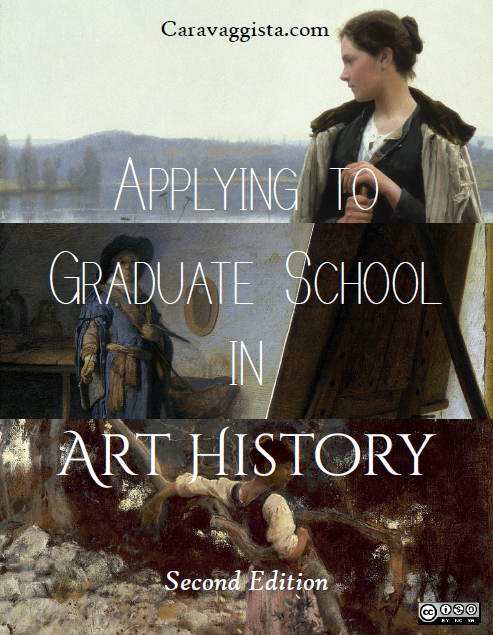
The cover of my grad school guide.

I just completed one of my summer projects, which was to design and write a guide for applying to graduate school in art history. If you’re interested, you can find it here. I’m so thrilled with the result. Many of my readers (and Tumblr followers) are undergraduates, so I wanted to provide them with a quick, simple guide to help them decide whether or not they want to pursue graduate studies in art history, and if they do, what that entails. I tried to be as thorough as I could without going overboard – there’s a list of recommended resources and further reading. I’m looking forward to tracking interest in it and I hope it’s helpful!

I hope to actively write for this site again over the summer & I’ll try to have something drafted soon!

Share

Tags: , , , ,

Henri Regnault, Salome (1870), Metropolitan Museum of Art

According to Mark’s Gospel, Salome’s mother Herodias wanted John the Baptist dead because he spoke out against her marriage to her brother-in-law, Herod. Herod would not put John to death, because he “feared John, knowing that he was a righteous and holy man…” (v. 20). The chance to silence John came one day when Herod was hosting a feast for dignitaries and military leaders. Salome, his stepdaughter, came to the banquet and danced for the party. Pleased with her dancing, he asked her if there was anything she wanted. The words are eerily reminiscent of Xerxes questions to Esther during their private banquet with Haman: “Ask me for whatever you wish, and I will give it to you … even up to half my kingdom.” (v. 22-23). Unlike Esther, Salome’s response was direct. As instructed by her mother, she asked for the head of John the Baptist. Not wanting to embarrass himself in front of his guests by breaking the promise of a gift (cf. v. 26), Herod ordered the execution. The executioner brought John’s head to Salome, who brought it to her triumphant mother.

Most depictions of Salome in the nineteenth-century depict Salome with John’s severed head, Salome alone near a blood trail (like Moreau did several times), or Salome dancing before Herod. Several factors may have influenced Henri Regnault’s depiction Salome from 1870. Salome was the ultimate femme fatale. Her beauty was dangerous and she used it to her advantage. The popularity of Salome as femme fatale was in part due to authors such as Flaubert, Huysmans, and Mallarme. Perhaps also influential was the art of Regnault’s contemporary, Gustave Moreau, who had been obsessively painting and drawing Salome as a dangerously unexpected seductress since at least the 1860s. In addition to being considered the ‘ideal’ femme fatale, the theme of Salome also lent itself to the nineteenth-century fascination with the Orient and the exotic. Finally, Regnault’s Salome may also have absorbed a long-standing historical interest in the severed head and the soul post-death.

Henri Regnault, Detail from Salome (1870)

But there is no severed head. And this is precisely what is perhaps most striking about Regnault’s Salome, for she holds all the accouterments of execution; the platter and dagger are within her control, resting on her lap, clean and without blood. Her facial expression is perhaps a mischievous one – she smirks and gazes confrontationally out at the viewer, fully aware of the ominous objects she holds. One hand wraps itself delicately around the dagger, perhaps ready to unsheathe it, while the other rests on her hip as her fingers lightly touch the chest she sits on. She wears a finely ornamented, gold gown that loosely falls over her shoulder. Her gown bunches up on the floor. One foot seems to slowly be making its escape from its slipper and rubbing itself against her other foot, a subtly seductive detail. Salome’s jewelry and belt, along with the leopard-skin rug and Eastern-style chest allude to Salome’s exotic nature. And this is not without merit, for, as a princess living in Galilee, the figure of Salome would have indeed been part of the exotic world of the nineteenth century Orient.

What of John’s head, her trophy? I would argue that Regnault’s Salome is a cleverly constructed piece wherein the viewer sees the true nature of the femme fatale. On the one hand, she is exotic, beautiful, and sensual. On the other, deadly.  Her beauty and finely ornamented clothing and possessions distract from her true nature as a seductress bent on blood – or if that is too anachronistic an interpretation, then bent on lust and distracting the artist from what truly matters – his art. Salome, along with the Sphinx and Judith, was a common allegory for the artist needing to triumph over lust and things that would distract him. Many artists of this time remained bachelors, even if they had mistresses. Salome’s (or, the femme fatale) ability to catch man off guard through her beauty, sensuality, and ornamentation, was a common literary and art-historical trope in Europe, but especially in Regnault’s France. Regnault’s Salome is a visual representation of the femme fatale so warned against in intellectual circles. John’s severed head is not needed; the viewer can use their imagination and the visual cues in the painting which suggest danger. On a literal level, Salome’s platter and dagger allude to the Biblical story, receiving as their prize John’s head. Symbolically, they allude to the overwhelming and destructive powers of lust, and Salome, without regret, takes as her prize the moral essence of the viewer.

To explore the painting in greater detail, visit its page at the Met website.

This is the second post on this site solely devoted to the figure of Salome. You can find the first, which was part of a series, here.

This post is modified from its first version on the Caravaggista Tumblr.

Share

Tags: , , , , , , , ,

This week, The Getty is hosting a Digital Art History lab with the intent of making progress on the question of how the field of art history can and should function in the digital age. As Diane Zorich masterfully outlined in her 2012 study of the state of digital art history, there are many obstacles the field faces as it moves forward – and there are also many biases that need to be addressed and dealt with. (I will talk about some of them here; links to this and other recommended materials are below.)

In her recent blog post for the Getty Iris, Murtha Baca, the head of the Getty Research Institute’s digital art history program, talked about what she calls the “St. Augustine Syndrome” — the perception and tradition of scholars writing and researching in solitude. This is perhaps the greatest problem facing art historians as we discuss what “digital art history” actually is, because not only does “digital art history” suggest an immense amount of collaboration and interaction with colleagues and even the public online, but the “St. Augustine Syndrome” also emphasizes the drastic difference between the reality of art history and the romance of art history. The reality of art history as it stands today is that there is a codified manner in which one gets published, advances their career, and becomes accepted and recognized as a member of the scholarly community. The romance of art history is that this can change. Digital art history efforts are increasing by individual scholars and institutions alike, and yet there is a serious problem in that these efforts are given little attention or credence. It is perhaps the worst for those who attempt digital publishing. With some specific exceptions, the work that scholars publish online is often not treated as equal to that of its print counterpart. It is, for whatever reason, perceived as a threat or simply as inferior work. Even if this is an unintentional or unconscious response from the art history community, the truth is that we cannot afford not to address these issues. A serious conversation must begin to take place among scholars about the viability of digital technology for furthering the field.

I mentioned that within art history, there is a codified manner in which we work. Must we feed these conventions? I’m not suggesting in any way that we reject traditional modes of scholarship (e.g., print publishing, conferences, etc.), but I am suggesting a reform within the field that finds impactful ways to use the technologies and international network given to us by the internet. Let’s discover and create new ways of practicing art history. Let’s redefine ‘art historian.’ In doing so, we’ll face practical and ideological roadblocks (discussed in Ms. Zorich’s report), but to get to a point where we can begin discussing these obstacles, we need to do a few things. First, we need to address the fact that the digital age isn’t going away. It’s not a fad. Art history will have to reckon with it at some point, so why not now?  Second, we need to recognize and dissect our biases. It is because these unspoken biases exist in the shadows that digital art history cannot advance. Third, we need to ask some hard questions, including things like: What would digital art history ideally look like? What would its publishing forms be? Where would print publishing fit into this? How would authors secure their copyright in this new form of scholarship? Would ‘digital art historians’ be a new breed of scholar?

I would also suggest that in addition to thinking about how the digital age can assist the art historical community, we begin efforts to make art history more accessible to the public. The Getty Research Institute has been a leader in this regard, as have many other museums and institutions. I specifically mean individuals and their work. Obviously, if one fails to see the merit of digital publishing, then sharing research online to the public is likely a ridiculous idea. Concern about online publication isn’t without reason; copyright infringement and plagiarism are easier than ever with the advent of the internet. But I think that for the public, there would be great value in having professional opinions and research available about art and art history. Misconceptions about art history and art abound, and scholars who are active and make their work available online can assist in dispelling some of those misconceptions. With digital art history, there is the possibility of taking education outside of university walls and into the vast, nearly limitless realm of the Web.  How art history and art historians fit into and interact with the public online is at least something to consider as part of the larger conversation about ‘digital art history.’

Art history is thriving… but more could be done. Right now, the conversation about digital art history is of a murky, confusing, uncomfortable sort, but we must address the elephant in the room, because the elephant is growing. We don’t want to find ourselves unprepared and scrambling for answers and solutions in 20 years because we failed to take the issue of digitality seriously. We are at an incredible moment in history where technology has made the world immediately accessible to us and us immediately accessible to the world. What will we do?


Author’s note: This article stems from a post I made in response to the Getty’s Tumblr asking for input about the state of art history in the digital age. The Getty’s Tumblr entry can be found here. My response received so much support (and was even mentioned in the Getty’s Google+ Hangout) that I decided to write this and expand on some of the ideas presented in that post. You can read it here.

Related links:

Murtha Baca,  Susan Edwards, and Anne Helmreich, ”Rethinking Art History,” recording of live Google+ Hangout, March 4, 2013.

Murtha Baca, “Rethinking Art History,” The Getty Iris, March 4, 2013.

Nuria Rodríguez Ortega, ”It’s Time to Rethink and Expand Art History for the Digital Age,” The Getty Iris, March 5, 2013.

Diane Zorich, “Transitioning to a Digital World: Art History, Its Research Centers, and Digital Scholarship,” Kress Foundation, 2012.

For a nice overview of these issues, I refer you to 3 Pipe Problem’s article “The Moment of Digital Art History?” (December 2012)


Share

Tags: , , , , , , , ,

LACMA’s recent exhibition Bodies & Shadows: Caravaggio and his Legacy (November 11, 2012 – February 10, 2013) is admittedly not the first U.S. show to bring together works by Michelangelo Merisi da Caravaggio and artists who emulated his style. 2010 marked the 400th anniversary of Caravaggio’s death, and the art world exploded with monographs, biographies, and exhibitions about Caravaggio. There have been Caravaggio and Caravaggisti exhibitions every year since. And the fascination with Caravaggio –  the cult of Caravaggio – only grows. Indeed, the catalogue that accompanies LACMA’s exhibition admits people must think: Caravaggio again?

Yes, Caravaggio again.

Much about Caravaggio’s life, personality, and art is still being resolved. And yet, the LACMA exhibition is hardly as much about Caravaggio as it is about the overwhelming impact he had on seventeenth century art. The curators purposefully avoid the term “followers” to describe those who employed Caravaggesque features in their art, and this is for a few reasons. Unlike some of his famous contemporaries, Caravaggio never had an academy or pupils; by his death, his style was so popular that he scarcely needed it. He had a circle of artist friends in Rome, but their relationships were not of a master-student type. Each artist shown at Bodies & Shadows had something unique about their style and each, perhaps more importantly, had their own personalities and imagination. This might seem like an obvious statement, but with Caravaggio studies, some things need to simply be restated lest we begin to take terms like “Caravaggisti,” “Caravaggism,” “Caravaggesque,” for granted. As Bodies & Shadows demonstrates, artists took freedoms with Caravaggio’s style and emphasized artistic elements from their region and/or their own specialties.  (As I’ve written previously, I think this would have particularly annoyed Caravaggio – but that is another story.) The important idea is that Caravaggio sparked a change in art that spread across western Europe with incredible speed, no doubt helped by his sojourn in Naples, Malta, and Sicily. For whatever reason, Caravaggio’s humble figures and dramatic chiaroscuro resonated with artists and patrons, and suddenly, it became the major mode of artistic expression.


Caravaggio, St. Francis in Ecstasy (c. 1594/5)

There are particularly powerful moments in Bodies & Shadows. As a Caravaggio specialist, you can probably imagine my emotional state when as soon as I walked in there were two of my favorite Caravaggios, the Ecstasy of St. Francis and St. John the Baptist within my immediate line of sight. I think I burst into tears. I can’t quite articulate how important it is to see works of art in person. Everything about them is different. You connect with them. I literally got on my knees so that I could see Caravaggio’s “sketch” with the back of his brush on the St. John. I could see the wet in Peter’s eyes as he pointed to himself and denied he knew Christ. I made a face at the sickly greenish-yellow color of John the Baptist’s head on a platter – realizing for the first time why Salome might be turning away … because it’s a severed head, and it looks like one. Obviously I knew this before, but slides don’t do justice to Caravaggio’s mastery of color and detail. Gerrit van Honthorst’s Christ Crowned with Thorns coupled with Jan Janssens’ work of the same name offered equally powerful moments. I was mesmerized by these two paintings. Both combine Caravaggesque lighting with truly remarkable expressions that bring the viewer face to face with a tender and wince-inducing moment in Christ’s passion, leaving the viewer to contemplate which side they’re on.


Georges de la Tour, Mary Magdalene with the Smoking Flame (c. 1638-40), Detail.

These powerful moments are not confined to single works of art. There were knock-out moments where I could spend a long time going back and forth between paintings looking at the way the artist applied paint to create hair, or fingernails, or jewelry. The exhibition’s design makes it fairly easy to walk back and forth between paintings by a specific artist for comparison. There is exquisite beauty in the smallest of details in the paintings at Bodies & Shadows, such as the sheerness of Judith’s shawl in Valentine de Boulogne’s Judith or the way Georges de la Tour renders shadow on Mary Magdalene’s bare shoulder as a piece of her hair delicately rests on it.


Caravaggio (attributed), The Tooth Puller (c. 1608/9)

There was a problematic moment in the show, too. I suspect I’m not (and won’t be) the only person who will mention The Tooth Puller (c. 1608), a painting in LACMA’s own collection attributed to Caravaggio. I have a tense “relationship” with this painting. (You can see some of my thoughts here.) I haven’t decided, even after seeing the work in person, whether or not I think it’s from Caravaggio’s hand. Seeing it in person was immensely fulfilling, and I spent a lot of time in front of the painting talking with my husband and brother-in-law about the differences of the work to the other Caravaggios we had just seen. There are passages in the painting that seemed to me to be drastically and blatantly different from the way Caravaggio handled paint in the other works shown at the exhibition. On the other hand, the sinister, eerie quality of a painting that has some wonderfully Caravaggesque details lends support to a Caravaggio creation. I’ll address the painting in more depth in a follow up post, but for now, the words of Keith Christiansen best describe my current thoughts about the painting: “If Caravaggio connoisseurship contains a lesson, it is that this revolutionary master is too unpredictable in character to fit any tightly constructed scheme of evolution or expectation.” (“Caravaggio and “L’esempio davanti del naturale,“ Art Bulletin, 1986)

Bodies & Shadows brings together art by artists of many nationalities to make a point about Caravaggio’s legacy. His legacy began at home, in Italy, when his art was in such high demand that when he wasn’t in Rome, there was an artistic void that artists could only hope to fill. It spread, with his exile, to Naples, Malta, and Sicily, and from there, to Spain and beyond. We find his influence in France with artists like Valentin de Boulogne and in the Dutch world, particularly in Utrecht, where artists’ experiments and inventions within Caravaggism secured his legacy amongst Northern Baroque artists. Artists influenced directly or indirectly by Caravaggio appropriated his chiaroscuro, earth tones, and humble figures, and his style, if that is even the correct term, became an undeniable, yet sometimes subtle force in their own art.

I’ve started to think of Caravaggio as a self-made man. I think he was someone who, arriving in the bustling artistic hub of Rome at the age of 21, knew exactly what he wanted to do with his talents but struggled for years to get there. And when he finally did, his career took off to such a startling degree that perhaps even he wasn’t expecting it. I think he enjoyed the fame and the commissions that came with it, because he had been effectively working toward it his whole life. This might be a romantic, populist viewpoint of an artist who is already constantly and tirelessly popularized, but I also think it’s a human viewpoint more than anything else. The one thing Bodies & Shadows made explicitly clear to me is that Michelangelo Merisi da Caravaggio, a man of unimaginable talent whose incredible skills of self-fashioning enabled him to become the most sought after artist in Rome, a man who created undeniably powerful works of art … was just a man. And yet, his legacy is so tremendous that he defies definition. He is simply Caravaggio.

~

Note: I urge you to see the show at LACMA before February 10th, when it closes. I strongly recommend buying the catalogue that accompanies this exhibition, Caravaggio and his Legacy ($40 USD). If you miss the exhibition at LACMA and can make it out to the East Coast, you’ll have a chance to experience Caravaggio at the Wadsworth. Burst of Light: Caravaggio and his Legacy will be running from March 6 – June 13 of this year.


Share

Tags: , , , , , , ,